These days, traffic accidents are raging through Cambodia. NRSC data shows that 1,509 people died, 2,273 suffered minor injuries, 1,447 were seriously injured in the 2,844 crashes, and 2,477 riders were found without helmets last year. Then, the Ministry of Labour and Vocational Training reported work-related crashes in 2,977 in the first half of 2025.
Although the government has imposed stricter laws, fines for non-compliant drivers, and nighttime alcohol checks, the number of casualties remains alarmingly high. Given that these measures have shown limited effectiveness, the following essay will examine the main causes of traffic accidents in Cambodia and examine their spillover into individuals, families, and society as a whole.
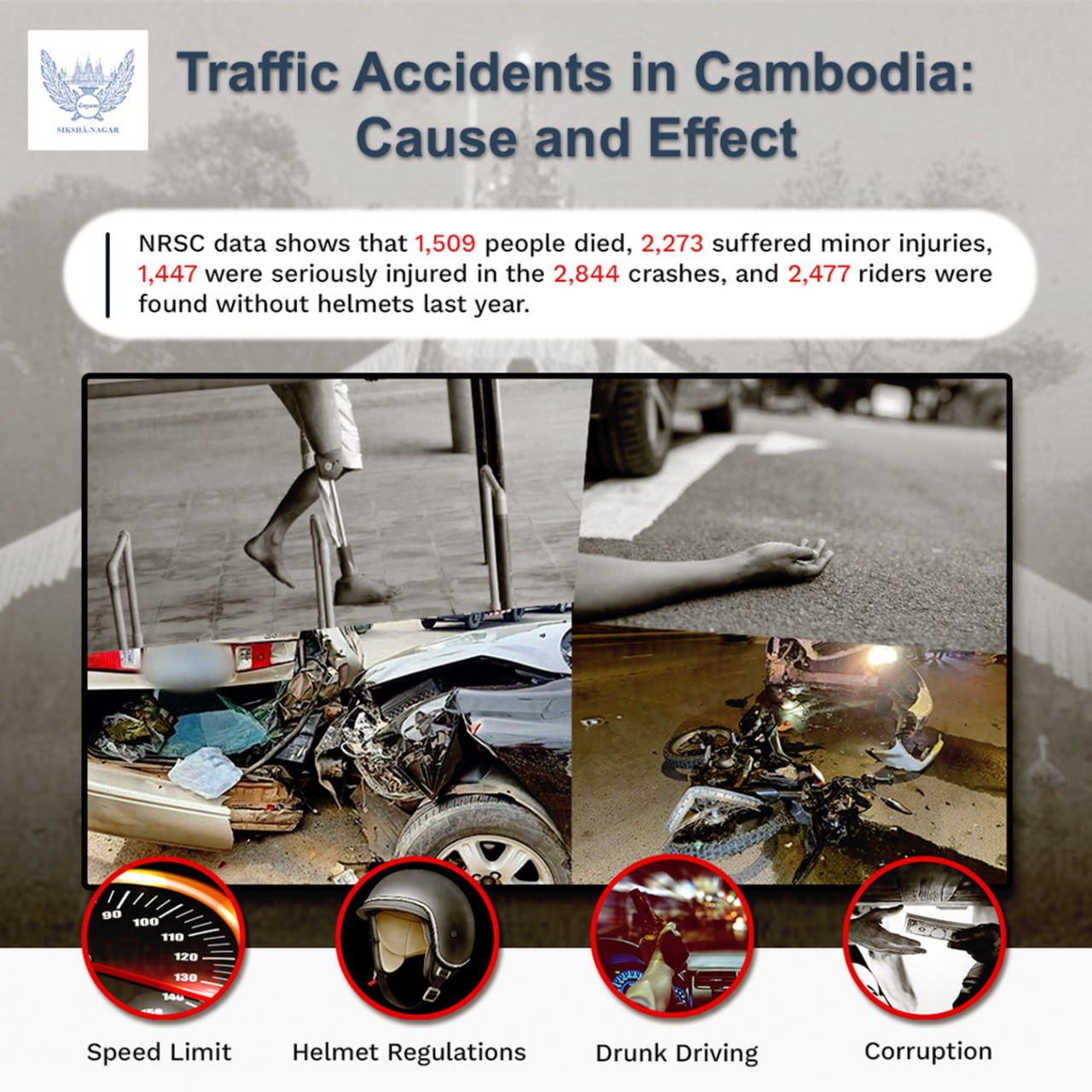
The primary reason for traffic accidents in Cambodia is simply that the people drive recklessly. It is a result of such factors as driving at excessive speed, driving under the influence of alcohol, and the failure to wear helmets or seatbelts, which not only harms the drivers themselves but also endangers pedestrians and other drivers. Impatience, overconfidence, and lack of real knowledge of road safety are the root causes of reckless driving. As an example, Hun Heng, the Chief of the Accounting, Logistics and Finance Department at the Phnom Penh Police Commissariat, was accused of driving under the influence of alcohol (0.45 mg/l) and reckless driving. However, his self-discharged test later reported it was merely 0.35 mg/l. He hit various vehicles outside the Ministry of Interior in Phnom Penh. Government statistics also indicate that in the first quarter of 2025, 51% of traffic accidents in Cambodia were related to speeding. The top reasons separated by the transport ministry included speed (1,156 cases, 40.6%), failure to respect right-of-way (649 cases, 23%), improper lane changes (268 cases, 9.4%), and reckless turning (221 cases, 8%). Risky overtaking (215 cases, 7.6%), vehicle defects (114 cases, 4%), and driving under the alcoholic influence (105 cases, only 3.7%), were other contributing factors.
Another critical challenge lies in the weak enforcement of existing traffic regulations, reflecting broader institutional and governance shortcomings. Although the speed limit, helmet regulations, and drunk driving are regulated in Cambodia, many motorists simply disregard them and believe they are okay. Corruption is also a contributing factor, since some drivers pay off traffic police officers in order to avoid paying fines. This leniency causes everybody to think that they are above the law without incurring any actual penalty. That corruption allows some drivers to bribe the police or use the loopholes to avoid punishment due to the conviction that they will not be caught and punished. This attitude transforms the traffic laws into an alternative and not a compulsory guideline. Consider the feature article that is entitled Traffic in Cambodia: A Game of Cat and Mouse. In its opinion, motorists will not violate the rules until there is a presence of a police checkpoint. As soon as they overcome it, they will forget their helmets, and accelerate once again, recklessly driving. Am Sam Ath, the operations director of LICADHO also told, some of the drivers have the authority and they have luxury cars; hence, they do not obey the road traffic laws. He went on to say that the law should be applied to all and enforced with force, no matter who you are. For instance, Som Nori Tikha was driving a luxury vehicle on December 5, 2022, with the alcohol concentration of 0.53mg/l in his body, and was involved in a collision with a motorcycle and another lady who was riding behind her small child. The offender and the victims also agreed on a settlement of $ 2,500 out of court.
Lastly, the absence of comprehensive road-safety education and limited public awareness have perpetuated the high incidence of traffic-related fatalities. In the rural areas, many young Cambodians are not trained to use roads in a proper manner or to take driving lessons. Such a level of ignorance culminates into individuals driving carelessly and disrespecting the laws. There is also no compulsory licensing of motorcycle riders unless they are above 125ccs, and so, there is a large number of untrained people on the road riding bikes without the slightest idea of the dangers. An investigation conducted by the Asia Injury Prevention Foundation revealed that there are still a lot of Cambodian drivers who do not get the fundamentals of the issue such as the importance of helmet-wearing or adhering to speed limit laws. This kind of ignorance maintains the fatality and accident rates.
Unfortunately, traffic accident led to loss of life and injuries. Cambodians are dying by the thousands immediately and some experience severe injury that would result in a permanent disability. Many of the victims are their primary breadwinners, meaning when they perish, families fall into poverty, children are deprived of education and the entire society experiences the social and economic shock in the long run. To top it all there are many more receiving permanent disabilities that damages the entire living standards and the future working population of the nation. All these facts help to understand that the country of Cambodia is in urgent need of effective road-safety precautions and the enhancement of the national traffic laws. Claiming 1,509 deaths in 2024 and 1,590 in 2023 the National Road Safety Committee claims that on average four people perish on Cambodian roads every day.
Traffic accidents also have tremendous economic implications. Severed families incur excessive medical expenses and risk lacking livelihood in case the breadwinner is killed or disabled. Actually, other families have resolved to sell their assets like land, houses, cars, or farmlands to cushion themselves against the economic consequences of being caught up in an accident. Even though Cambodia is a country that has a small household of 17 million, accidents decrease the productivity of the country due to the loss of skilled workers. Traffic accidents have an enormous economic cost to the Cambodian people, both on the family and the national economy. In 2021, the expenditure related to death and severe injuries in road accidents were estimated at 1billion dollars, which is approximately 5 percent of the GDP of Cambodia.
Moreover, traffic accidents also have several social impacts in Cambodia. Children die in accidents and leave orphans and vulnerable families. Those survivors with permanent disabilities can end up being reliant on relatives to provide assistance and support on a daily basis. As an illustration, the death of parents/principal caregivers in road accidents leaves children orphans or without any proper care. This bereavement may cause emotional trauma and interfere with the development and well-being of the child. In others, the surviving children might be taken to residential care facilities where they might become even more isolated by their communities and support systems. In addition, the loss or incapacitation of a breadwinner by the effect of inconsequence tends to compel the eldest child to quit school in order to earn a living to feed the family. This transition may result in child labor where children are hired in different industries, some of which may be dangerous. It is further complicated by the fact that there is no mandatory education requirement and therefore a large number of kids are exposed to exploitation. Finally, the post-traumatic stress associated with the death of a loved one in a road crash may cause mental health complications in both survivors and family members. Psychologists have observed that fear and sorrow surrounding such events are major issues in the Cambodian society.
In conclusion, Cambodia’s traffic crisis transcends individual incidents; it reflects deeper structural challenges encompassing governance, public behavior, and socioeconomic resilience. The issue of road rage, laxity in implementation of traffic regulations, corruption and absence of proper road-safety education perpetuate the danger cycle on our streets. Not all crashes result in immediate fatalities or injuries, the after-shocks strike families and the life within the community children have no place to live, families become poorer, victims experience disabilities throughout their lives. These tragedies demonstrate that we must have a holistic approach: tougher enforcement of the law, more regular fines and penalties, road-rule education and a culture change to responsible driving. All the lives lost on Cambodian roads make us all get up and implement safety. Cambodia can eliminate these avoidable tragedies, save families, and create a society in which the future chances are not subdued by negligence. Students, government, and communities need to unite their efforts to make the streets safer to guarantee the future, dreams, and lives of so many Cambodians.
Author:
– Chanmakara Heun: Junior IR at Paragon International University